
I look at my toe and foot and realize that someday both will have no flesh, becoming simply bones made primarily of calcium and various other elements and compounds. The numerous foot bones will become disarticulated and will themselves slowly dissolve. They will last longer as individual component bones, but eventually they too will be gone. No flesh, no ligaments, no tendons, no blood, no lymph – in short, no life. But where will I be? Where will my essence be? I have not existed for what is essentially the life of the universe: 13.8 billion years; at least not in any way I remember, which is in effect the same thing. I can’t recall when I wasn’t. While it is true that that what physically constitutes me has been here in a myriad of forms throughout this time, it was not ME, possibly others, but not me. 13.8 billion years is a very a long time not to exist. But I do now. This little tiny piece of the universe, me, has been brought to consciousness, and will someday, relatively soon, dissolve back into the Universe. To what end, if any? Is there a point to any of it, a point to me? It is the fundamental existential question. I know I am not the first to consider it, and I know I certainly won’t be the last.
I am not sure my traditional faith provides the answers anymore in terms of reason, rationale, or salvation. It seems completely nonsensical. I do like the story of Jesus. I find it uplifting in a way. I see those with faith around me, but is it in any way based in reality? But do I have any faith that it is? The truth is I want it to be true. Wanting it to be true and wanting faith is not the same as having belief and faith. The irony is that I want to believe in something beyond, something, but I find the traditional and varied alternative options (other Christian faiths, monotheisms etc.) sorely lacking.
Is there anything beyond? Is there a link to any thing beyond? Perhaps this is really cliche. I do seem to be obsessed with the future and death. Perhaps I just need to relax and live in the now: the every-present and eternal now. Enjoy today for tomorrow we may…
The term Breaking Through, coined by Ed Ricketts, is a puzzling one. Ricketts influence in ecology has, somewhat belated, been appreciated though it is well known that he was very influential on Joseph Campbell and John Steinbeck’s writing decades ago.
Just what was Ed Ricketts on about with respect to his concept of Breaking Through? What does this mean? It is a phrase seemingly linked to transcendentalist thought, as Ricketts was heavily influenced by such thinkers as Thoreau and Emerson to name a few. It is difficult concept, one I don’t think Ricketts himself understood well, or least could not articulate in a straightforward manner. It seems to be based in an ecological perspective, of which he is famously one of the first to embrace. However, as is often the case, mere words fail to adequately express the ineffable. His essay on the topic is dense and hard to follow. After reading it, repeatedly, do I have any inkling of what he was talking about? Is he talking about a link to something ‘more’ but not necessarily religious in a traditional sense? It seems trite to say ‘spiritual’, so I won’t. But I don’t think that is what he meant by his term either. Some sort of connectedness was what he was emphasizing, a consciousness based not on some ‘nebulous’ feeling, but rather on our actually connectedness to actual living organisms, a sense of place, ecological in nature, gleaned through such connections, and on to the wider expanse ‘beyond’. Is this what he meant? Or am I reading too much into his ideas?
He was interested in producing a series of essays collected together in a volume called ‘Participation’. He died before it could be brought to fruition. This seems to be a better conceptual term than that of ‘breaking through’ or ‘non-teleological thinking’, his other rather awkward phrase relating to these ideas. Being ‘fully alive’ within your place and experiencing the deep relationships between individuals in place (human and otherwise) seems to be what this was about. Interconnectedness at the local level extending out from to the non-local, ultimately to the universal. This is somewhat more straightforward I think; more concrete. Or is it? It seems to be, at least in my mind. But does it have any practical significance? Does it have any value beyond my own thoughts?
One very practical question that arises: Does one have to be knowledgeable to get the connection? Is this an elitist kind of thing? Do you need to be a birder to get a connection with birds? Or study damselflies to get any kind of inkling of their lives? Perhaps I need to finish Karl Oves work…is it too self-referential? Am I?
Does this relate to in some manner to biocentrism? Is there a connection to Robert Lanza’s ideas? I have started re-reading, or more accurately, listening to his book. The principles of biocentrism are quite interesting and are a direct result of quantum mechanics and double slit experiments and are based on modern understanding of physics. The leap to the understanding of consciousness is very much that: a leap. How exactly does our consciousness create reality? Whose consciousness created it? His key question: Is the moon there when I don’t look at it? His conclusion seems extraordinarily counter-intuitive. I think I reject his conclusions: perhaps I am not quite ready accept this findings. It does seem quite outlandish. His second book, Beyond Biocentrism, covers much of the same ground but extends to a discussion of death and the now.
Maybe I am overthinking this completely. Perhaps more simply I should try to understand how do other living things relate to the universe and their place in it? Do they even care? I am reminded of a cartoon where numerous animals at various points in their evolution state simply eat, survive, reproduce, until we get to us…then it is ‘What is it all about?’ Should we not just accept that is about the eat, survive, reproduce? Why do we think and expect that it must be more? 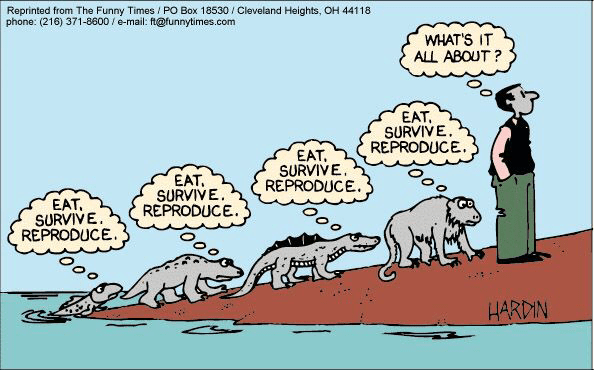
Categories: Ponderings
 Walden Ponderings
Leave a comment